Step-by-Step Guide for Florida HOA & Condo Boards
Transitioning to a new HOA management company is one of the most important decisions a board can make. It affects financial oversight, vendor performance, homeowner communication, compliance enforcement, and the overall stability of the community.
Many Florida HOA and condo boards delay making a change because they assume the process will be stressful, disruptive, or complicated. In reality, a management transition can be smooth and well-organized if the board follows the correct steps and works with a company that has a proven onboarding process.
This guide outlines exactly how Florida HOA and condo boards can transition to a new management company step-by-step, including common mistakes to avoid and what a successful transition should look like.
Step 1: Confirm the Board’s Reasons for Transitioning
Before starting the process, the board should clearly document why the association is considering a management transition. This ensures the decision is based on facts and not frustration in the moment.
Common reasons Florida HOAs and condo associations transition to a new management company include:
Lack of responsiveness or delayed communication
Inconsistent financial reporting
Vendor service delays and lack of follow-up
Poor meeting preparation and board support
Lack of budget guidance or reserve planning support
High turnover and inconsistent staffing
Ongoing homeowner dissatisfaction
Weak violation tracking or architectural request support
If the board has communicated concerns repeatedly and the same issues continue for several months, it may be time to explore professional alternatives.
Step 2: Review Your Current Management Contract Carefully
Florida HOA management agreements typically include strict termination clauses, notice requirements, and auto-renewal language. Boards should never assume they can transition quickly without confirming the contract terms.
Key contract items to review include:
Required notice period (30, 60, or 90 days)
Auto-renewal deadlines
Early termination penalties
Required termination delivery method (certified mail, email, written letter, etc.)
Record transfer requirements
Financial transition responsibilities
Scope of services and reporting expectations
If the contract language is unclear, it is recommended to consult association legal counsel before taking formal action.
Boards should also ensure contract actions align with governing documents and applicable Florida laws. Florida HOA and condo statutes can be reviewed here:
Florida HOA and Condo Statutes: https://www.leg.state.fl.us/statutes/
Step 3: Build a Transition Timeline Before Making Announcements
One of the most common mistakes boards make is announcing a transition too early. A management change impacts payments, vendors, architectural requests, homeowner communication, maintenance processes, and financial reporting.
Before giving notice, boards should outline a transition plan that includes:
Target start date for the new management company
Board point of contact for the transition
Vendor notification schedule
Homeowner communication schedule
Payment and portal transition plan
Record and financial access transfer plan
First board meeting expectations with the new management company
A clear timeline prevents confusion and reduces disruption.
Step 4: Request Proposals From Qualified Florida Management Companies
Once the board is prepared, the next step is requesting proposals from reputable HOA and condo management companies with Florida experience.
Boards should request proposals from 2–4 firms and compare them based on structure, staffing, reporting, and operational support.
When reviewing proposals, boards should ask:
Will the community have a dedicated LCAM?
What is the manager-to-community workload ratio?
What does monthly financial reporting include?
Do they support budget preparation and reserve planning?
How are vendors managed and tracked?
What is their process for violations and compliance?
How are architectural requests handled?
How is after-hours support managed?
What software platform do they use?
What does onboarding look like and how long does it take?
A strong management company should provide a clear onboarding timeline and explain the transition process in detail.
Before selecting a new management company, Florida HOA and condo boards should confirm the firm employs properly licensed Community Association Managers (CAMs). You can verify CAM licensing through the Florida Department of Business & Professional Regulation (DBPR) here:
Florida DBPR CAM Licensing Information: https://www.myfloridalicense.com/
Step 5: Compare Management Companies Using a Board Scorecard
While pricing is important, boards should evaluate what they are receiving in exchange for the monthly management fee. Many associations choose the lowest-cost option and later discover they are sacrificing service quality and accountability.
Boards should compare proposals based on:
Financial reporting structure and transparency
Communication standards and response expectations
Vendor oversight procedures
Meeting preparation and board support
Compliance tracking systems
Technology platforms and homeowner portal support
Transition process and onboarding structure
A well-run management company provides consistency and reduces risk for the board.
HOA Management Transition Checklist for Florida HOA & Condo Boards
If your board is planning a management change, use this quick checklist to stay organized and avoid missed steps during the transition process.
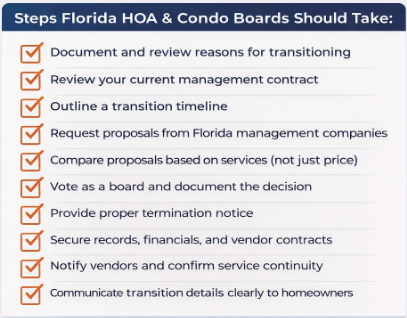
- Review your current HOA management contract and termination clause
- Confirm required notice period (30/60/90 days)
- Create a transition timeline before making announcements
- Request proposals from qualified Florida management companies
- Compare proposals based on services, reporting, and support (not just price)
- Vote as a board and document the decision in meeting minutes
- Provide proper termination notice to the current management company
- Secure association records, financials, and vendor contracts
- Notify vendors and confirm service continuity
- Communicate payment and portal changes clearly to homeowners
Step 6: Vote as a Board and Document the Decision Properly
Once a management company is selected, the board should document the decision formally.
Depending on governing documents, this may include:
A board vote during an official meeting
Meeting minutes documenting the motion
Final contract approval
Legal review of contract terms if needed
This is also the best time to confirm the official start date and onboarding schedule.
Step 7: Provide Proper Termination Notice to the Current Management Company
After selecting a new management company, the board must provide termination notice in writing, following the contract requirements exactly.
Termination notices should include:
Official termination date
Required notice period confirmation
Request for record transfer
Request for financial documentation
Board point of contact information
Maintaining a professional tone during the transition is recommended, even if frustrations exist.
Step 8: Secure Association Records, Financials, and Vendor Contracts
One of the most critical parts of transitioning to a new management company is ensuring all association records and financial documents are properly transferred.
Boards should confirm the association receives:
Financial Records
General ledger and financial statements
Current budget and prior year budgets
Bank statements and account access information
Accounts payable and accounts receivable reports
Delinquency list
Reserve schedules and reserve reports
Audit history (if applicable)
Administrative Records
Governing documents and amendments
Rules and regulations
Meeting minutes
Owner rosters and mailing lists
Insurance policies and claim history
Vendor contracts and renewal dates
Maintenance logs and open work orders
Compliance and Community Records
Architectural request history
Violation tracking logs
Active enforcement items
Pending disputes or homeowner issues
A professional management company will assist in organizing and verifying all required documents during onboarding.
During a transition, boards should confirm all insurance policies and claim history are organized and up to date. Helpful resources are available through the state here:
Florida Department of Financial Services: https://www.myfloridacfo.com/
Step 9: Notify Vendors and Confirm Continuity of Services
Vendor communication is essential during a transition. Service delays or billing confusion can cause unnecessary homeowner complaints.
Boards should ensure vendors are notified of:
New management contact information
Updated invoice submission process
Work order request procedures
Emergency service contact instructions
Approval process for projects and repairs
A qualified management company will coordinate vendor communication early to prevent disruption.
Step 10: Communicate the Transition Clearly to Homeowners
Homeowners often become concerned when they hear management is changing. Clear communication keeps residents informed and prevents confusion.
A homeowner announcement should include:
Effective transition date
New office contact information
Payment and mailing instructions
Portal login details (if changing systems)
Emergency maintenance procedures
Reassurance that services will continue smoothly
Strong management companies typically provide homeowner announcement templates and communication schedules to support the board.
How Long Does a Florida HOA Management Transition Take?
Most HOA and condo management transitions in Florida take 30 to 90 days, depending on the termination notice period and the complexity of the association.
Communities with onsite staff, large budgets, multiple vendors, or complex financial histories may require additional onboarding time.
Common Mistakes Florida HOA Boards Should Avoid During a Transition
Even experienced boards can make mistakes during a management transition. Common issues include:
Not reviewing the termination clause before acting
Announcing the change too early
Selecting a company based on price instead of service structure
Failing to secure financial and vendor records early
Confusing homeowners with unclear payment instructions
Not establishing a transition timeline and onboarding checklist
The most successful transitions are structured, documented, and supported by a management company with proven onboarding systems.
A Successful Transition Requires Structure
Transitioning to a new HOA management company can be one of the best decisions a board makes—especially when it improves communication, financial oversight, vendor accountability, and resident satisfaction.
With the right planning, the transition process does not have to be disruptive. A strong management company will provide structure, timelines, and professional support to ensure continuity of service and smooth onboarding.
Request a Management Proposal
If your board is considering a transition, Empire Management Group provides HOA and condo management services across Florida, supporting communities from Sarasota to St. Augustine with responsive communication, strong financial oversight, and proven onboarding systems.
📌 Request a proposal here:
https://empirehoa.com/request-proposal/
How do Florida HOA boards terminate a management contract?
Most contracts require 30–90 days written notice. Boards should follow the contract’s termination method exactly and document the decision in meeting minutes.
How long does it take to transition to a new HOA management company?
Most transitions take 30–90 days depending on contract terms and how quickly records and financials are transferred.
What documents should a board request when changing management companies?
Boards should request financial reports, bank access documents, vendor contracts, owner rosters, meeting minutes, insurance policies, and violation and architectural request records.
Should homeowners be notified before switching management companies?
Boards should wait until the transition plan is finalized and the new start date is confirmed before notifying homeowners.
What should boards look for in a new Florida HOA management company?
Boards should look for financial transparency, dedicated LCAM support, vendor oversight systems, strong communication processes, and an organized onboarding plan.